Compute Validation for Jobs
Overview
Compute validation extends beyond benchmarks to encompass actual client job executions. Republic ensures that jobs submitted to validators are completed correctly, efficiently, and verifiably.
Workflow
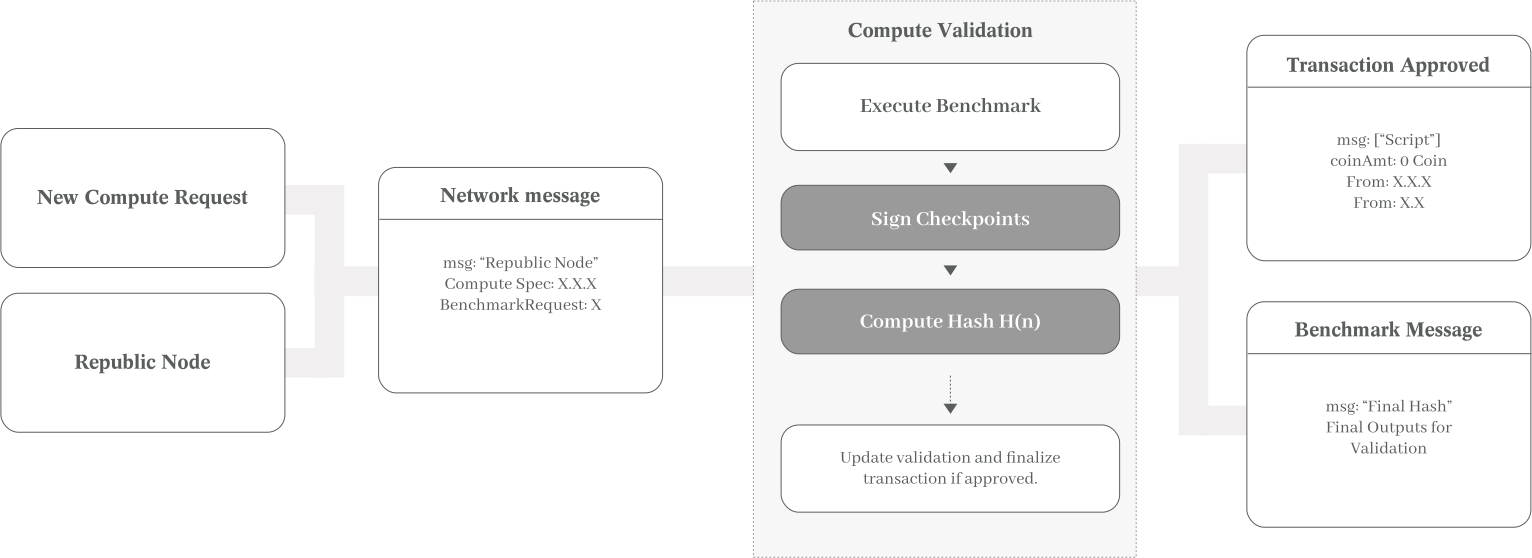
-
A job is scheduled at time .
-
The validator executes and returns results at .
-
The job’s compute complexity, measured in FLOPs, is predetermined from the job specification.
-
The achieved FLOPS is calculated:
-
Validators must submit proof artifacts, including model checkpoint hashes (planned), along with output correctness.
Validation Criteria
- Validators must meet or exceed their baseline achieved FLOPS benchmark.
- Output correctness is verified within numerical tolerances.
- Failure to meet standards may result in reputation loss or slashing penalties.
Future Verification Model
The planned checkpoint hashing scheme will allow multiple validators to verify parts of the job execution collaboratively, enhancing security and scalability.
Impact on Consensus
Validators with strong compute validation records have increased chances of being selected for consensus committees and earning token rewards, aligning incentives with network performance.